I say yes, you say no, OR People are Strange
Comments
-
I love history, but tend to gravitate toward WWII, the Civil War and the Amerian Revolution. I have every one of Steven Ambrose's WWII books. I figure they will be a collector's item for my kids someday as I now only read on my kindle.
-
I didn't like history so much in school but find myself exploring all sorts of geneological information. A trip to Scotland after chemo was part of that where I stomped on my ancestors' footprints.
Does chemo cause travelling?
-
While the Brits revere and treasure their past, they refuse to live in it:
Courtesy of the BBC:
Failing to teach evolution by natural selection in science lessons could lead to new free schools losing their funding under government changes.
The new rules state that from 2013, all free schools in England must teach evolution as a "comprehensive and coherent scientific theory".
The move follows scientists' concerns that free schools run by creationists might avoid teaching evolution.
Sir Paul Nurse, president of the Royal Society, said he was "delighted".
Sir Paul told BBC News the previous rules on free schools and the teaching of evolution versus creationism had been "not tight enough".
He said that although the previous rules had confined creationism to religious education lessons, "the Royal Society identified a potential issue that schools could have avoided teaching evolution by natural selection in science lessons or dealt with it in a such a perfunctory way, that the main experience for students was the creationist myth". -
Scotland-anyone read the "Outlander" books? History, science fiction, and romance all rolled into one. I've read the first 3 in the series, but I'm taking a break.
Mary
-
oh yes!! there is a trip advertized somewhere to take you to the sites in Scotland that are mentioned in the books.
-
I am a history freak (the word buff wouldn't sufficiently capture it). My specialty is 20th century, but I find it all fascinating.
Yorkie, I loved Ambrose's Citizen Soldiers: The U. S. Army from the Normandy Beaches to the Bulge to the Surrender of Germany.
Riley - love that picture. I only went to the Tower once and my strongest memory was of the crown jewels. But I so agree. Despite it's history, the Tower gives on a sense of peace.
Speaking of the Tower, and of how Hollywood and others distort history, do you recall the time when Elizabeth learned of Leicester's marriage and her first reaction was to order him to the Tower? The Helen Mirren Version simply had her breaking down into tears -- so un-Elizabethan. Arghhhh! Annoyed me no end to see that.
-
Athena, that was incredible! Also loved D-Day and Band of Soldiers. In addition to WWII he wrote an awesome book about Lewis and Clark called Undaunted Courage.
-
Quiet cloudy Sunday. I have finished a pint of Ben & Jerry's Vanilla Heath Bar Crunch in one sitting. My stomach looks something like this:

-
Jealous. Something lately about ice cream and my tummy has gone very wrong. I never had a dairy problem but now milk and ice cream send me into digestive hell.
Have to find a new food vice. Chocolate in any form! -
Chick -- An aunt of mine developed celiac disease in her late 50's. Another one (on the other side of the family) was dx'ed with celiac in her late 70's. She also cannot consume dairy products without major tummy troubles. So, unfortunately, these autoimmune disorders can occur at any age -- just frequently takes awhile for an accurate dx.
-
Lindasa you are probably on the right track, although I thought celiac was a gluten thing. Didn't know dairy was part of the problem too.
It's always something, ain't it. -
Athena, I rolled my eyes at that, too. People were tougher back then. And after everything Elizabeth had survived, she would NOT have blubbered. Yelled and thrown things, yes. Cried privately afterward, sure. Also, in my continuing role as historic killjoy, Elizabeth knew Leicester was married; it wasn't a secret, she was his friend from childhood, and she attended the wedding. I think the Elizabeth movie was trying (clumsily) to add a dramatic event from much later in her life, when Leicester's step-son got too big for his britches when Elizabeth wouldn't continue to let him do what he pleased. He openly defied her, nearly drew HIS SWORD ON HER during an argument before he caught himself, burst into her private apartments one morning before she was dressed to argue with her some more (getting in a cheap shot about her "twisted old carcass" while he was at it), and raised an army to march on the palace to "save" her from those horrible people who'd obviously turned her against him <rolleyes>. He lost his head for that, and it broke her heart and humiliated her. She'd indulged him because he reminded her of Leicester, who'd died, and because he'd flirted with and flattered her. And it was all a con against an old woman.
I'm going to have to look for the "Outlander" series. I googled it briefly and found a single 600 page book; are there more, or did they combine several into one massive tome?
-
Riley-Every one of the "Outlander" series books I have read so far is at least 600 pages.
 I'm taking a break after 3 of them-I think there are at least 4 more. "Outlander" is only the first book.
Mary
-
So here, on this quiet Sunday (Chick - I envy YOU on the ice cream bit. Ben & Jerry's is the enemy of a good silouette!) is a "Renaissance 101" primer. The word is French for "re-birth." The main tenet of the Renaissance was humanism - the notion overturning centuries of Dark Ages thought, that God was the center. Humanism posits that man/woman lie at the center.
At the same time that Galileo committed heresy by proposing that the earth was not the center of the universe. Columbus proved that the world was round by not dropping off in his journey to the Americas.
It was an era of unprecedented technological advances, including the compass, for navigation. And there came Leonardo da Vinci with his wonderful sketches. Leonardo is also the main proponent of a simple but at the time revolutionary concept in art - the use of perspective.
Notice how, in The Last Supper, everything is aligned with a point on the horizon:

This was a foreign concept in most Medieval art, which essentially looked like this:
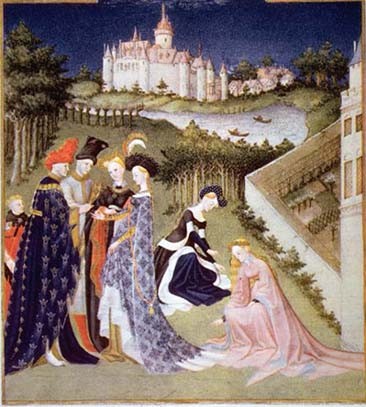
-
Back to the concept of humanism, Botticelli and Raphael are other prominent masters. Before, since the fall of Rome, Europe mostly had religious art. So Raphael and Botticelli were novel in reviving some of the pagan themes:
Here is Botticelli's Birth of Venus:
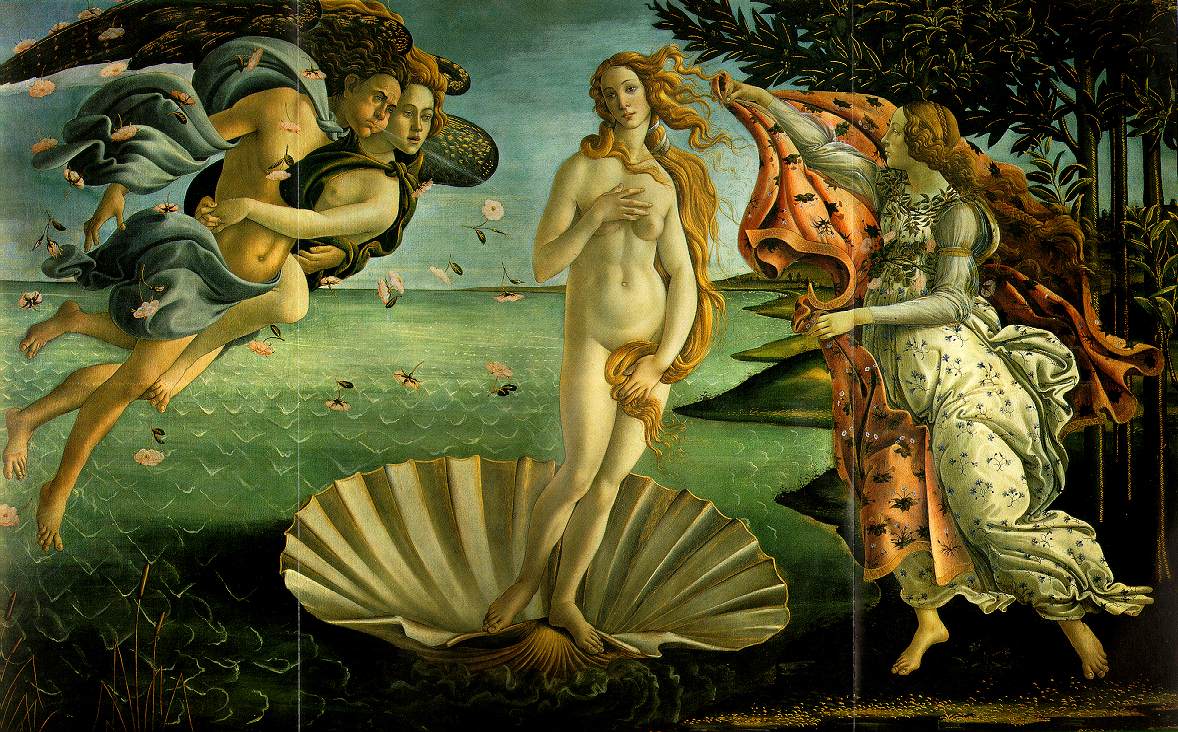
and his Primavera ("Spring")
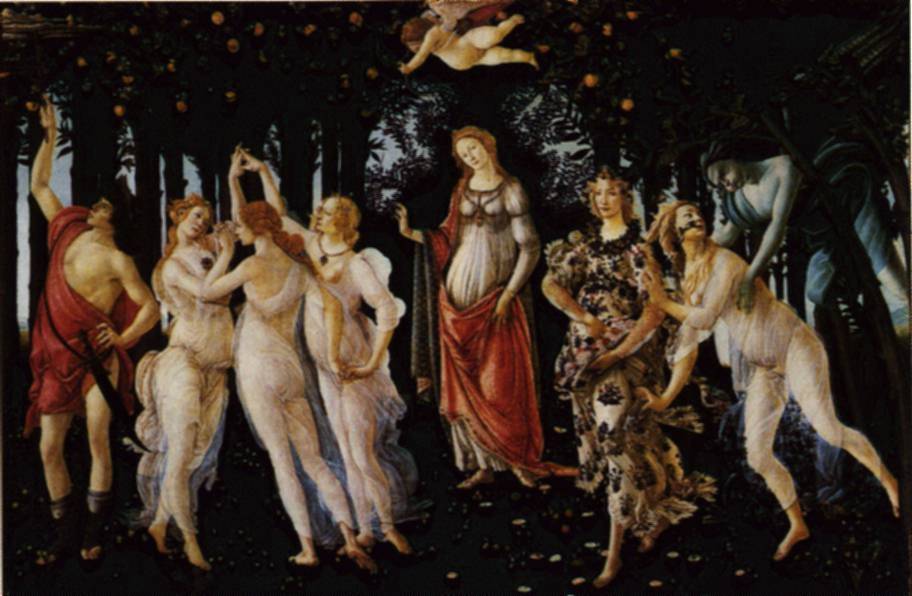
It was not only the departure from religious art that was revolutionary, but also the emphasis on earthly emotions, joy, and the depiction of three-dimensional human figures which depart from the rather flat figures you saw in Medieval art.
-
Chick -- Yes, celiacs cannot digest gluten. But I was actually commenting on how food "allergies" (for want of a better word!) can affect us at any age. The aunt who was dx'd with celiac in her late 70's also discovered that she had become intolerant of dairy, so, by process of elimination (no pun intended!!) she found her gastro troubles totally disappeared when she stopped dairy products (which she LOVES!). Life is not fair.....
By the same token, tots and children with asthma or excema, for example, frequently outgrow it.....but some don't.
I wish some bright young researchers would discover the real reason why food allergies have increased exponentially over the last 25 years.
-
And then, of course, there is Raphael:

Raphael, if you notice above, was another master at the use of perspective. This painting, entitled The School of Athens, was meant to convey, generally speaking, knowledge and scholarship as exemplified by the Ancients.
-
Michelangelo is often thought of as a product of the Renaissance, but strictly speaking he comes somewhat later. Anyway, here is his David. I first saw it as a child when it was still shown outside. It has since been moved inside - I think it's still at the Uffizi gallery in Florence. Nearby there are loads of souvenir shops carrying small statues of the David. None capture what Michelangelo managed to:
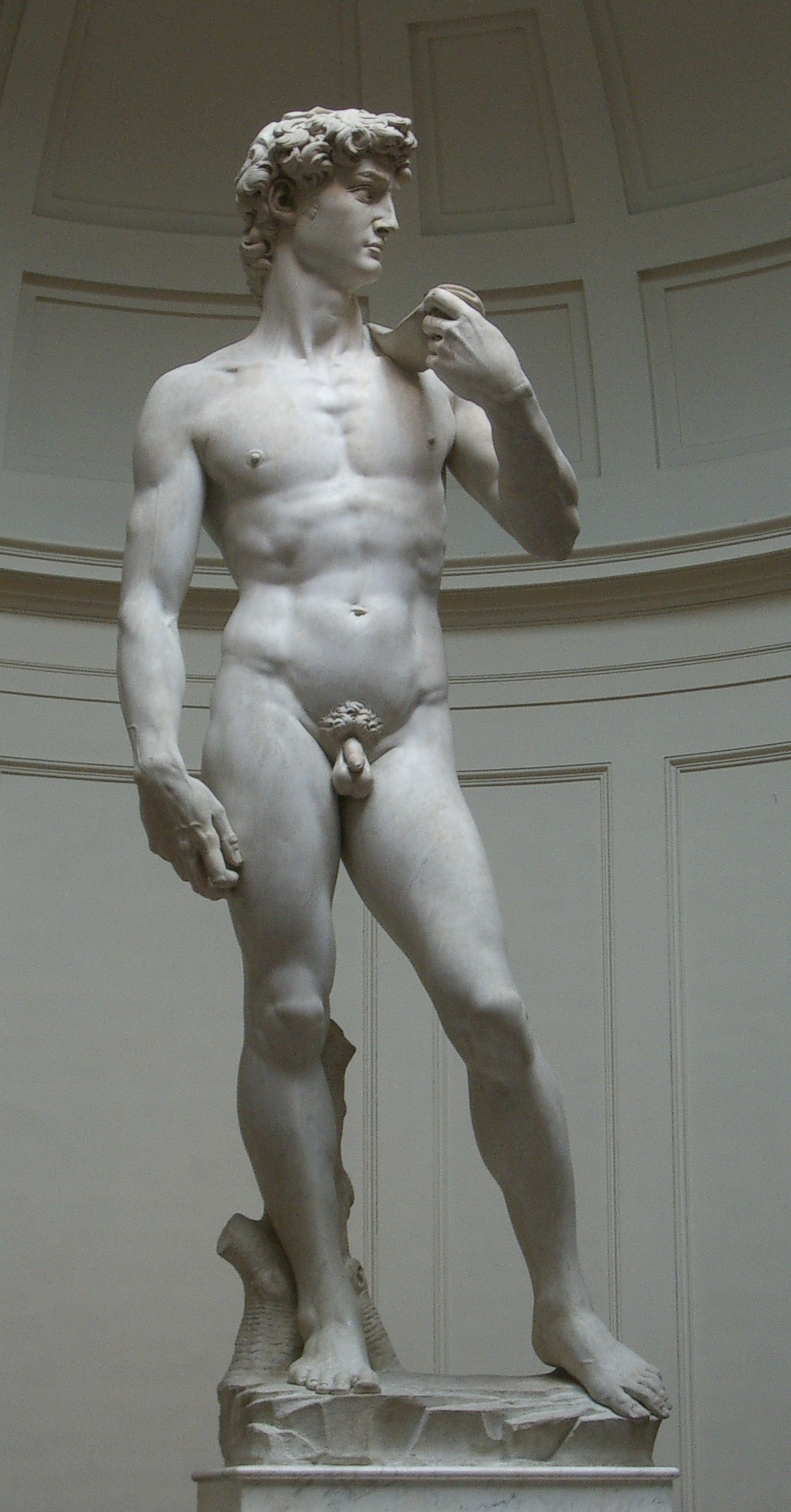
-
I said a few pages back that El Greco was a mannerist - but many critics say he is too unique to be classed into a single art form. However, the reason why I bring him up here is that he, like many Renaissance masters before his time, also continued religious themes but with a deeply human and often tortured tone. To understand this point, compare and contrast the El Greco, immediately below, with the uni-dimensional Medieval triptych that follows:

(El Greco's Pieta)
-
Oops - back to the High Rennaissance (roughly, late 15th to early 16th century) because we HAVE to mention Titian - here is his Venus:

-
This is all to explain how art became human....so let's jump a few centuries forward to the time when photography had been invented and art slowly became abstract. Cezanne and Seurat are considered to be two forefathers of the impressionists, which are considered, in their way, to be the first abstracts in that they were the first to worry less about how objects actually were and instead were concerned with how they appeared. Monet is probably the best known impressionist:

-
Hello, I've been reading for a number of months and you all are wonderful. I enjoyed the October/November commentary. I am really enjoying the art discussion. Thank you.
-
The preoccupation with how things appeared, coming at the end of the 19th century, was not uncoincidental. As the 20th century dawned, war, industrialization and technology spelled the ending of an old world order. It was a time of trauma, uncertainty, extremism in Europe and a sense of fatalism - the feeling that technology and war could spell the end of humanity. This was compounded by the fact that religion is no longer the center of philosophical thought. Science is. And the cubists, led by Picasso and Braque, incorporate this preoccupation via shape, form, geometry and analytics in their art. At the height of the cubist era, here is Picasso's Les Demoiselles d'Avignon (the young ladies of Avignon)

Braque - one of my favorites - his Violin and Candlestick:
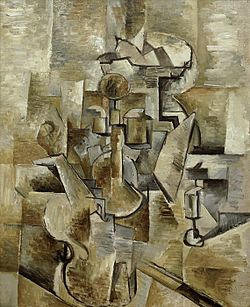
The preoccupation of cubism is not to depict an object as it looks to us but as it really is - with the parts that we don't see, such as those that are behind. The argument of cubism proponents was that a shape's innate characteristics --including the parts that are invisible to us-- are more real than what we can see with our eyes.
Picasso in his cubist period - the painting below depicts what is known as analytic cubism:

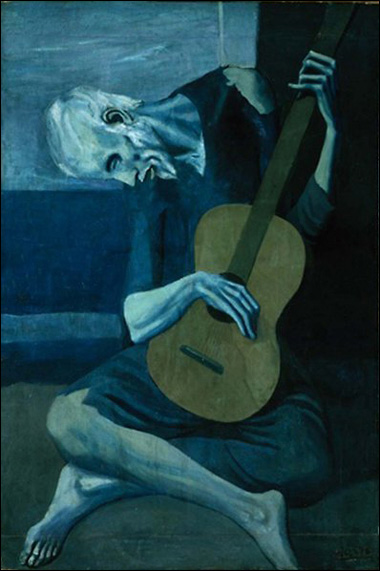
Picasso went through many evolutions in his art. His "blue" period, which came just before his cubism one, already depicted that early 20th century angst while already hinting at abstraction and away from the faithful depiction of human forms:
-
Thanks, Juliaanna! Hope you'll stick around (and please feel free to jump in anytime/anywhere).
I was inspired by the art discussion to spend yesterday afternoon at the museum. I stumbled into the Robert Lehman wing at the Met -- it's very eclectic, basically everything that Lehman collected as an individual and then bequeathed to the museum, so it takes in European and Middle Eastern ceramics, various decorative items, medieval religious painting and some gorgeous impressionist and fauvist and don't-know-what-to-call them European paintings from the 19th and 20th centuries. I "met" a couple of artists I wasn't familiar with.
Linda
-
I mentioned earlier the growing preoccupation with technology as defining to thought in the early 20th century. This was expressed in art and architecture in many ways, including by the Futurism movement, which became obsessed with showing how technology and industrialization had dominated the consciousness of the time. Futurism was a brief movement, but I find it emblematic:
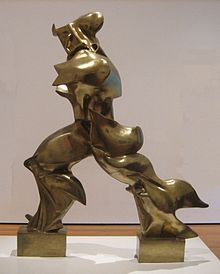
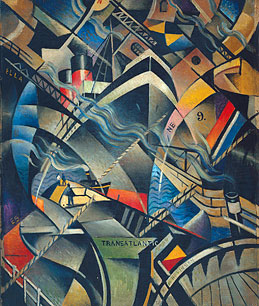
Futurism, as per its "Manifesto," was meant to celebrate speed, violence, machinery, youth and industry. It was UNHEARD of, at the time, to lump such conepts together. In many ways, futureism, IMO, predates the irreverence which has become so very mainstream these days. Here are some more expressions of that movement:


-
Welcome Juliaanna!
-
Hi juliaanna! Welcome!
The art discussion is fascinating, isn't it? You never know what you'll learn on this thread!
Athena, thank you for posting photos of such wonderful works of art. I like pieces that show "movement" (for lack of a better word) so van Gogh and Rodin are favorites of mine. Rodin's Burghers of Calais fascinated me since I read of it long ago. I was pleased to discover it at the Hirshhorn!
And now, my daily "Prisoner of Medicare" update:
Morning fog shrouded my bedroom windows. My bowels have become unruly and a pimple garnishes my chin. Tomorrow I approach my oncs with Medicare card and metaphorical hat in hand.
Based on Fox News and Drudge reports, government doctors will likely implant an Obamachip into my arm so that "they " can monitor my whereabouts and freedom-lovin' capitalistic activities, and perhaps even control my thoughts! The next time I report, I may be an Obamabot.
Wish me luck, friends. -
Speaking of art and the crossover of styles into other art forms, French Impressionism may be a prime example. Monet, Cezanne et al were contemporaries of Claude Debussy. For an example of impressionism in music there is no better piece than Debussy's "Jardin Sous la Pluie" (Garden in/under the Rain). Google and listen to it and picture, in your mind, a misty garden with the rain falling, and a hint of thunder. It's beautiful! Of course, "Clair de Lune" is another fine example, but perhaps not as "explicit".....
Welcome, Julianna! I love your name, a favourite niece of mine is named Julianna -- it's so musical!
-
E - Make sure to take your tax forms - you KNOW the guv'mint needs those BEFORE they agree to treat you!
And here is the Rodin you refer to:

-
Welcome Juliaanna! This is a great place to be. I don't say much sometimes but I am always reading and learning. Glad you enjoyed our October/November discussions.
I see that you are a fellow Pacific Northwesterner!
Mary


Categories
- All Categories
- 679 Advocacy and Fund-Raising
- 289 Advocacy
- 68 I've Donated to Breastcancer.org in honor of....
- Test
- 322 Walks, Runs and Fundraising Events for Breastcancer.org
- 5.6K Community Connections
- 282 Middle Age 40-60(ish) Years Old With Breast Cancer
- 53 Australians and New Zealanders Affected by Breast Cancer
- 208 Black Women or Men With Breast Cancer
- 684 Canadians Affected by Breast Cancer
- 1.5K Caring for Someone with Breast cancer
- 455 Caring for Someone with Stage IV or Mets
- 260 High Risk of Recurrence or Second Breast Cancer
- 22 International, Non-English Speakers With Breast Cancer
- 16 Latinas/Hispanics With Breast Cancer
- 189 LGBTQA+ With Breast Cancer
- 152 May Their Memory Live On
- 85 Member Matchup & Virtual Support Meetups
- 375 Members by Location
- 291 Older Than 60 Years Old With Breast Cancer
- 177 Singles With Breast Cancer
- 869 Young With Breast Cancer
- 50.4K Connecting With Others Who Have a Similar Diagnosis
- 204 Breast Cancer with Another Diagnosis or Comorbidity
- 4K DCIS (Ductal Carcinoma In Situ)
- 79 DCIS plus HER2-positive Microinvasion
- 529 Genetic Testing
- 2.2K HER2+ (Positive) Breast Cancer
- 1.5K IBC (Inflammatory Breast Cancer)
- 3.4K IDC (Invasive Ductal Carcinoma)
- 1.5K ILC (Invasive Lobular Carcinoma)
- 999 Just Diagnosed With a Recurrence or Metastasis
- 652 LCIS (Lobular Carcinoma In Situ)
- 193 Less Common Types of Breast Cancer
- 252 Male Breast Cancer
- 86 Mixed Type Breast Cancer
- 3.1K Not Diagnosed With a Recurrence or Metastases but Concerned
- 189 Palliative Therapy/Hospice Care
- 488 Second or Third Breast Cancer
- 1.2K Stage I Breast Cancer
- 313 Stage II Breast Cancer
- 3.8K Stage III Breast Cancer
- 2.5K Triple-Negative Breast Cancer
- 13.1K Day-to-Day Matters
- 132 All things COVID-19 or coronavirus
- 87 BCO Free-Cycle: Give or Trade Items Related to Breast Cancer
- 5.9K Clinical Trials, Research News, Podcasts, and Study Results
- 86 Coping with Holidays, Special Days and Anniversaries
- 828 Employment, Insurance, and Other Financial Issues
- 101 Family and Family Planning Matters
- Family Issues for Those Who Have Breast Cancer
- 26 Furry friends
- 1.8K Humor and Games
- 1.6K Mental Health: Because Cancer Doesn't Just Affect Your Breasts
- 706 Recipe Swap for Healthy Living
- 704 Recommend Your Resources
- 171 Sex & Relationship Matters
- 9 The Political Corner
- 874 Working on Your Fitness
- 4.5K Moving On & Finding Inspiration After Breast Cancer
- 394 Bonded by Breast Cancer
- 3.1K Life After Breast Cancer
- 806 Prayers and Spiritual Support
- 285 Who or What Inspires You?
- 28.7K Not Diagnosed But Concerned
- 1K Benign Breast Conditions
- 2.3K High Risk for Breast Cancer
- 18K Not Diagnosed But Worried
- 7.4K Waiting for Test Results
- 603 Site News and Announcements
- 560 Comments, Suggestions, Feature Requests
- 39 Mod Announcements, Breastcancer.org News, Blog Entries, Podcasts
- 4 Survey, Interview and Participant Requests: Need your Help!
- 61.9K Tests, Treatments & Side Effects
- 586 Alternative Medicine
- 255 Bone Health and Bone Loss
- 11.4K Breast Reconstruction
- 7.9K Chemotherapy - Before, During, and After
- 2.7K Complementary and Holistic Medicine and Treatment
- 775 Diagnosed and Waiting for Test Results
- 7.8K Hormonal Therapy - Before, During, and After
- 50 Immunotherapy - Before, During, and After
- 7.4K Just Diagnosed
- 1.4K Living Without Reconstruction After a Mastectomy
- 5.2K Lymphedema
- 3.6K Managing Side Effects of Breast Cancer and Its Treatment
- 591 Pain
- 3.9K Radiation Therapy - Before, During, and After
- 8.4K Surgery - Before, During, and After
- 109 Welcome to Breastcancer.org
- 98 Acknowledging and honoring our Community
- 11 Info & Resources for New Patients & Members From the Team