Getting Healthcare Reform That Will Work for US
Comments
-
Well the title of this thread is getting health care reform that will work for the US. How about if the age for medicare is reduced, year by year? 64 next year, 63 the year after. There will be a problem because medicare will be picking up more of the high need people, but maybe less than expected because HMOs are already "cherry picking" and companies are dumping older employees.
-
I haven't posted in a very long time. Good to see this discussion about health care reform. I am tangled in my own nightmare and have put off testing for a long while now. I can't afford the $5000 ded. and then 50/50 pay after that is met. Not in 2009. I pay a little over $400/month for health care coverage that I can't even afford to use! What is the point? Do I go in debt over this disease and drag my entire family down? Health care reform is not a joke, and really, I don't even see that it needs to be debated. It's a broken machine, and it needs to be fixed. I suppose it's how it is going to be fixed that would be debated. Not "if." But it does need to be soon. Not only for me, or you, but for everyone else that is going to be dx tomorrow, and the day after that and the day after that. We deserve good health care, and shouldn't have to go broke or die trying.
-
Hi, Shirley. Good to see you again.
mke, that's a really interesting proposal about Medicare. I have to say I am very worried about my sister. She is younger than I am, but was hoping that, if she managed her finances well, she could retire in her late-50's. The stock market/economic crash took care of that dream, because she has no fixed ("defined") pension plan-- just her 401(k), which was gutted.
But health care is another issue. Even though she has full, liberal insurance coverage right now through her employer (which happens to be a health care provider), the employee coverage stops when she retires. I don't know if they figure everyone gets picked up by Medicare or what. So, if she wants to retire early (before Medicare kicks in at 65), she will have to buy an individual policy and pay the entire premium out-of-pocket. She's not high risk -- she has no medical problems at all, except a sister who's had breast cancer, and I'm BRCA negative. Even so, can you imagine what it would cost to buy an individual health insurance policy for a woman in her late 50's? Sheesh.
The idea of gradually decreasing the age for Medicare eligibility is very attractive. I know there is strong disagreement among the factions about the number of people in the U.S. who are not covered by health insurance. (Whether it is not available to them, it costs too much, or they've declined out of naivety/stupidity/denial of the risks is a whole 'nother debate.) Does anyone have data on who those uninsured people really are? How many of them are in their late 50's and early 60's and would benefit from mke's suggestion?
otter (too early... need more COFFEE!)
-
Here's an idea I've been kicking around. Perhaps the reason that US healthcare is so expensive is because of insurance itself. Think about it - insurance companies represent a whole layer of profit-taking between the patient and doctor. Of course the insurance companies are in the business to make money, and who do you think pays for their profit? Situations that threaten that profit - serious illnesses, pre-existing conditions, etc. - encourage life insurance companies to ration health care by refusing treatment or even cancelling the insurance for those with serious illnesses.
Another thought - where there's profit to be made, there's fraud. Do a google search on health care fraud and the results are incredible. One site estimates that fraud increases our health care costs by 10%.
Finally, the paperwork, time, and effort required by doctors to submit claims adds to their costs, which of course get passed on to us. My OB/GYN has a full-time person devoted to insurance issues, and she has a small practice. That's a full-time person with benefits. Ridiculous.
I don't know what the solution is. Perhaps we could go back to the insurance coverage we had in the '70s. I remember my parents paid out-of-pocket for regular doctor visits and prescriptions; insurance coverage was for catastrophic illnesses and I believe it was called "major medical." If we converted to that type of system now, I think the cost of dr visits would fall for two reasons - market pressure (doctors would have to lower their fees to a range acceptable to their customers, or risk losing market share), and decreased administrative costs for physicians.
Just a thought.
E
-
I don't know what the solution is. Perhaps we could go back to the insurance coverage we had in the '70s. I remember my parents paid out-of-pocket for regular doctor visits and prescriptions; insurance coverage was for catastrophic illnesses and I believe it was called "major medical." If we converted to that type of system now, I think the cost of dr visits would fall for two reasons - market pressure (doctors would have to lower their fees to a range acceptable to their customers, or risk losing market share), and decreased administrative costs for physicians.
I don't know exactly when we went from not-for-profit hospitals and insurance companies to the profit driven corporations that they've become today. I don't know if we can put that particular genie back into the bottle without further damaging the economy at a time when it is hanging on by a thread. Wouldn't it be nice if we could find a legal way to do that without destroying the economy? Of course even non-profits can have overpaid executives, and that would be a much better place to start the cost slashing than Medicare (Advantage) benefits.
I think that much of the shift to covering more and more basic expenses can be traced to the advent of HMO's. Once people saw that those plans were covering routine care, they demanded the same coverage, and while a once a year physical for a healthy individual likely to participate in an HMO wasn't that big an expense, covering all the visits at that level for someone with a chronic condition has proven expensive for the more traditional plans.
-
I know we need reform...some kind of reform.
My dd who is turning 40 has been on on Cobra since she left the law firm for whom she worked. She and friend started their own practice. She was checking prices and from BCBS. She had me look at plans with her. I told her to not use a plan that had a life time max. And, we figured out few other things. The insurance she choose would have cost about $350 which she could afford. After filling out her history with NO MAJOR health problems the monthly increase was about twice the amount quoted...$700. She has migranes and her doc put her on an antidpressant to see if it would help. She had an accident a couple of months ago...a car rear-ended her, thus causing back pain. The insurance company asked if she had been to see a Chiropractor five times this year. Her answer was yes. Her Chiro treatments are paid for by the insurance company that belonged to the car. They asked a couple more questions and the answers were very benign. And, they gave no room for explanation.
I think something like this is very unfair. BTW, she's checking on insurance through the Bar Association and will wait to see with what they come up offer.
Yes, something needs to be done. What? I'm waiting for a realistic answser. Of course I still believe that many people should be discussing this entire health care debate...doctors, nurses, insurance companies, pharma, hospitals, our elected representatives...and probably many more who participate in delivering our health care.
-
When it comes to insurance after retirement or not, and a higher salary and less coverage versus a lower salary and lifetime coverage, I chose the latter. My retirement is much less than it could have been if I had worked in corporate/business world rather than the academic/educational institution world. It was a tough choice to make and means less travel, but more hope that I can keep my home.
My kids will probably not be able to buy a house even if they get affordable insurance. What my parents were able to do and we were able to do in our lifetime is not what will happen in their lifetime or my grandchildren. In our area of the country most jobs pay just enough to keep you above the poverty level, but far enough above that you will be bankrupt paying the insurance premiums or the medical bill if you can't afford insurance. Times have changed and the middle class is slowly slipping away. I expect that we will see upper class and lower class in the next few years if changes aren't made.
I don't believe pharmceuticals should be advertising their drugs on TV or in print for the public, I also don't like that reps from these companies give perks to the medical providers to get them to prescribe their meds. Heaps and heaps of free samples are given out. We end up paying for those also.
I can see any specialist in my area without going through my PCP, however, the specialists won't see the patient without a referral. So a catch 22! If you don't have insurance you must see your PCP and pay $, then pay the specialist you are referred to and if that isnt the issue, you just keep repeating the scenario.
I do believe that most docts and medical personnel are not out to get rich quick, but I do believe the insurance cos want to make as much $$ as they can. And then there are the pharmaceuticals--arguments are made that they spend so much in research, they have to recoup their costs--well, doesn't our purchasing of all the drugs for years and years get applied to that research? And the costs seem to keep rising! And the discovery of all these new drugs mean the companies can register the drugs and for years they are kept off the open market until the patent changes.
I really don't like that the pharma & ins cos are making millions and trillions off the backs of every person on this planet. Shouldn't healthcare be a non-profit business?
pomegranate -
It really irks me that a doctor, who has spent a lot on their education and is making life and death decisions everyday, are making a lot less than a bunch of health industry bureaucrats. Doesn't seem right.
-
There's no question that the insurance companies are a HUGE part of the problem. That is why the public option is a great idea! Those fat companies need some competition, and not from each other as they are almost all connected anyway, and go by the same rules. Its designed to make them wealthy, not to take care of people. Check out how much real estate is owned by these insurance companies, and all the investments they have. They have went far of course from what they were intended to do.
-
Athena,
I would argue that the reason drug companies charge so much in the States is because most people have insurance that pay for the bulk of it. If we didn't have insurance and couldn't pay that much, prices would drop. Again, we're back to insurance.
E
-
The president (not trying to be political), behind closed doors, made a deal with pharma. They agreed to give $80 billion over 10 years. No negotiating prices..not making buy drugs from Canada legal. I believe Bush did the same thing...no negotiating. That's not a great idea.
http://www.huffingtonpost.com/2009/08/13/internal-memo-confirms-bi_n_258285.html
Internal Memo Confirms Big Giveaways In White House Deal With Big Pharma
A memo obtained by the Huffington Post confirms that the White House and the pharmaceutical lobby secretly agreed to precisely the sort of wide-ranging deal that both parties have been denying over the past week.
The memo, which according to a knowledgeable health care lobbyist was prepared by a person directly involved in the negotiations, lists exactly what the White House gave up, and what it got in return.
It says the White House agreed to oppose any congressional efforts to use the government's leverage to bargain for lower drug prices or import drugs from Canada -- and also agreed not to pursue Medicare rebates or shift some drugs from Medicare Part B to Medicare Part D, which would cost Big Pharma billions in reduced reimbursements.
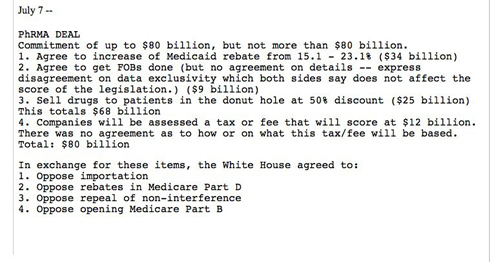
In exchange, the Pharmaceutical Researchers and Manufacturers Association (PhRMA) agreed to cut $80 billion in projected costs to taxpayers and senior citizens over ten years. Or, as the memo says: "Commitment of up to $80 billion, but not more than $80 billion."
Representatives from both the White House and PhRMA, shown the outline, adamantly denied that it reflected reality. PhRMA senior vice president Ken Johnson said that the outline "is simply not accurate." "This memo isn't accurate and does not reflect the agreement with the drug companies," said White House spokesman Reid Cherlin.Stories in the Los Angeles Times and the New York Times last week indicated that the administration was confirming that such a deal had been made.
Critics on Capitol Hill and online responded with outrage at the reports that Obama had gone behind their backs and sold the reform movement short. Furthermore, the deal seemed to be a betrayal of several promises made by then-Sen. Obama during the presidential campaign, among them that he would use the power of government to drive down the costs of drugs to Medicare and that negotiations would be conducted in the open.
And over the past several days, both the White House and PhRMA have offered a series of sometimes conflicting accounts of what happened in an attempt to walk back the story.
The White House meeting took place on July 7th, as first reported that evening in the Wall Street Journal. Also on the same day, a health care lobbyist following the talks was provided the outline of the deal by a person inside the negotiations. That outline had been floating around K Street before being obtained by the Huffington Post. In order to learn more about its origin, HuffPost agreed not to reveal the name of the lobbyist who originally received it.
"That is the PhRMA deal," said the lobbyist of the outline. He then clarified, "It was the PhRMA deal."
The deal, as outlined in the memo:
Commitment of up to $80 billion, but not more than $80 billion.
1. Agree to increase of Medicaid rebate from 15.1 - 23.1% ($34 billion)
2. Agree to get FOBs done (but no agreement on details -- express disagreement on data exclusivity which both sides say does not affect the score of the legislation.) ($9 billion)
3. Sell drugs to patients in the donut hole at 50% discount ($25 billion)
This totals $68 billion4. Companies will be assessed a tax or fee that will score at $12 billion. There was no agreement as to how or on what this tax/fee will be based.
Total: $80 billion
In exchange for these items, the White House agreed to:1. Oppose importation
2. Oppose rebates in Medicare Part D
3. Oppose repeal of non-interference
4. Oppose opening Medicare Part B
"Non-interference" is the industry term for the status quo, in which government-driven price negotiations are barred. In other words, the government is "interfering" in the market if it negotiates lower prices. The ban on negotiating was led through Congress in 2003 by then-Rep. Billy Tauzin (R-La.), who is now the head of PhRMA.
The rebates reference is to Medicare overpayments Big Pharma managed to wrangle from the Republican Congress that Democrats are trying to recoup. The House bill would require Big Pharma to return some of that money. The rebate proposal would save $63 billion over ten years, according to the Congressional Budget Office. The White House, given the chance, declined to tell the Wall Street Journal for a July 17th article that it supported the effort to pursue the rebates.
The Medicare Part B item refers to "infusion drugs," which can be administered at home. If they fall under Part B, Big Pharma gets paid more than under Part D. The agreement would leave infusion drugs in Part B.
In the section on Big Pharma's concessions, "FOBs" refers to follow-on biological drugs. Democrats have pushed to make it easier to allow generic drug makers to produce cheaper versions of such drugs, an effort Big Pharma has resisted. The Senate health committee bill gives drug makers 12 years of market exclusivity, five more than the White House proposed.
PhRMA's Johnson cast doubts on the provenance of the outline. "The memo, as described, is simply not accurate," he said in a statement. "Anyone could have written it. Unless it comes from our board of directors, it's not worth the paper it's written on. Clearly, someone is trying to short circuit our efforts to try and make health care reform a reality this year. That's not going to happen. Too much is at stake for both patients and the U.S. economy. Our new ads supporting health care reform are starting this week, and we are redoubling our efforts to drive awareness of why this issue is so important to America's future."
Johnson added that "no outside lobbyists -- not a single one -- were ever involved in our discussions with the Senate Finance Committee or the White House so someone is blowing smoke."
But the lobbyist who was given the outline defended its authenticity. And although the White House now says that drug price negotiations and reimportation were not actually discussed in the talks with PhRMA, the lobbyist said: "Well, that's bull -- that's baloney. That was part of the deal, for them not to push that."
The new uncertainty surrounding the deal comes after House Speaker Nancy Pelosi (D-Calif.) has repeatedly said that her chamber is not bound by any agreement it is not a party to. On July 8th, the day after the Journal reported some elements of the deal, Energy and Commerce Committee Chairman Henry Waxman (D-Calif.) said in a public speech that his committee would not be tied down by the agreement.
Before recess, he followed through. His committee passed a bill that allowed for re-importation and drug-price negotiations.
In the Senate, Democrats Sherrod Brown (Ohio) and Byron Dorgan (N.D.) pressed White House officials at a closed-door meeting last week, asking whether the White House had tied the Senate's hands.
The health care lobbyist said that what deal still exists is uncertain, as a result of House pressure. "Now the White House is backing away from it, as you know, because of pressure from the House, because the House was not a party to the deal," he said. "The Speaker put enormous pressure on the White House, [saying], 'We weren't a party to it and we reserve the right to do whatever we want.' And which they did in the House Energy and Commerce Committee bill, which led the White House to say, 'Well, maybe it's not cast in concrete.'"
Obama is walking a tightrope here. He wants to keep PhRMA from opposing the bill, and benefits by having its support, which now includes a $150 million advertising campaign. That's a fortune in politics -- more than Republican presidential candidate John McCain spent on advertising during his entire campaign -- but it's loose change in the pharmaceutical business.
Opponents of the deal with PhRMA hope that Obama is playing a multilayered game, making a deal in order to keep the drug makers in his camp for now, but planning to double-cross them in the end if he needs to in order to pass his signature initiative.
Big Pharma, however, is still comfortable. "As far as the pharmaceutical industry, PhRMA and its member companies, yes, they say a deal is a deal. We'll see what happens," said the health care lobbyist.
-
This whole thing confuses me and I'm not sure why it's such a bad idea. Shirley, are you saying that the government SHOULD negotiate drug prices with pharmaceutical companies? Isn't that what's happening here? A negotiation of sorts?
Regardless, I don't think the White House can make unilateral changes to Medicare. Somebody correct me if I'm wrong, please! And if anyone out there can explain what's going on in simple terms, please clue me in!
E
-
I agree with everyone else who thinks pharmaceuticals should NOT be advertised on TV. When did this start happening? They could save US money by stopping the stupidity. When I hear about all the side effects it makes me want to run away from their ads. And the Neulasta ad they used to have on. I wanted to through a brick through my TV.
I am in favor of capitalism. I'm not rich so I wouldn't mind some of that wealth..LOL When I think about doctors not being reimbursed fairly it makes me angry. Even a plumber can many times make more per hour than a highly educated doctor. My dd is an attorney. When she worked for a large law firm their fees per hour was out of this world. They mostly represented corporations. Now that she's on her own she, of course, does not charge as much as the big firm did. However, she makes $$$ per hour than most doctors. And think about how many years doctors "train." So, where do we draw the line when it comes to compensating our doctors? <sigh> That's why I feel like doctors and other professions need to be working on any health care reform. Not just the law makers. They have absolutely no idea.
-
WE have government health care in America.... it is called medicare. All they need to do is fund it and change the ages!
What no one seems to address is the corruption involved at all levels. Insurance companies who have CEO's who also are lobbiests, medical supply companies who have one price if you pay cash and more than triple the cost if they have to submit an insurance claim, Doctors who bill patient "A" for the injection and separate for the serum, while they bill patien "B" only for the injection of the exact formula! Major insurance companies where some agents are in a position to make and do make 4-500,000. per year while the others are in a department that only allows them to make 30,000. no matter what they do! I know this for a fact as my husband was with that company and when he asked about it, since he didn't believe it was true... his bosssaid, "Oh, you can't get in that group.... I can't even get in that group!" (These were the "good ole boys" from a major city and a MAJOR company!
My dd works for a major hospital and is already hearing from the physicians the "formula" that will be used in deciding which tests a patient can get. If they have met the quota for people who need to be on a feeding IV< then in order to put someone else on, they will have to take someone off... because the money will only go so far!
I think all of the politicians are corrupt, both sides of the isle and they don't have a clue what we are living with, and they really mostly don't care. We should all have the same care that our senators have while they don't ever pay any social security, etc.!!!!!
Comments? How many of you knew any of this?
-
Shirley, I agree with you. I understand our economic system -- I know why a professional basketball player or a college football coach can be making millions of dollars a year while a family doctor struggles to keep her nurse practitioner on the payroll. I know why that happens, but I don't like it and I'm certainly not proud of it. Why can't people be paid according to what they are worth to society??? Shouldn't a very good 3rd-grade teacher or a family doctor be worth more than a movie actress? But, that's not the economic system we have in this country. We aren't going to change hundreds of years of history in the next few weeks (or years, or decades).
We have to figure out how to work within the system we have.
So... Who should be crafting these changes in our healthcare system? Surely not the legislators who are beneficiaries of huge donations from pharmaceutical companies. But it's not just the drug companies who've been trying to influence our legislators. The AMA, AARP, hospital administrators, device manufacturers, ... even patient advocacy groups -- everyone wants a piece of the pie.
I am disgusted with Big Pharma, and I do think they ought to be reined in. For example, I think the prohibition on price negotiations for prescription drugs was a huge disservice to Medicare recipients. And, I think the FDA should loosen its ban on importation of prescription drugs ... provided the FDA can prove to us that it is capable of inspecting overseas facilities and ensuring the purity of the products. So far, it has failed that test miserably. I understand why drugs cost so much more here than they do in other countries -- It's mainly due to price controls that we don't have. Let's please try to equalize those costs without "restraint of trade" (which is illegal).
And there needs to be a ban on direct-to-consumer advertising of prescription drugs. I was going to say "reinstatement of a ban," but apparently there never was a ban. The explosion in direct-to-consumer advertising of drugs supposedly dates back to 1997. That's when the FDA released "guidelines" on what was required in a direct-to-consumer advertisement of a prescription drug. Before 1997, there were few guidelines that explained what content was acceptable and what was not. Apparently, the drug companies responded enthusiastically to those new guidelines. Some people say the rise of "consumerism" also contributed to the increase in direct-to-consumer advertising.
Here is an article in New England Journal of Medicine (2007) that discusses the subject: http://content.nejm.org/cgi/content/abstract/357/7/673
Sorry. Got off track there. Who should be contributing to the legislation that will change our healthcare system? Everyone, I'm afraid. Doctors, nurses, radiology techs, hospital administrators, nursing home managers, medical device manufacturers, patient advocacy groups, medical schools, labor unions, public health agencies, retirees' organizations, ... [insert your favorites here] ... and, yes, insurance companies and big pharma. The list is huge, but all of the stakeholders must be heard. Proposals drawn up without input from the major groups that will be affected should be voted down, and their sponsors (the legislators) voted OUT. The same should be true for anything that is fast-tracked to circumvent adequate public review.
Some people say a healthcare reform package must be passed quickly because it is long overdue. But, really--why should we accept a questionable or shabby product now, hoping it can be re-tooled and patched up later? Let's get everyone onboard and do it right. Some people argue that a lengthy opportunity for public review will result in greater criticism, more lies and fear-mongering, and worse. So, give everyone time to learn about the proposal. Then rebut the criticism; disprove the lies. Justify the components of the plan. Be proud of what you've done -- be able to defend it. Don't try to sneak it by us, hoping no one will notice.
I think sometimes our legislators forget that they work for us -- not the other way around.
otter
-
Well said Otter!
-
very well said otter.
I'd like to know why they voted against the requirement that the bill be available on line for 72 hrs before voting. I was furious at the suggestion that I, as a taxpayer, was incapable of reading it and understanding. Oh Mr. Congressman, want to make a bet on that????
I would like to see us do thoughtful and accurate changes. I don't want us to "throw out the baby with the bath water."
-
Carol, although this discussion appears fairly new, it is not. Unfortunately, a great deal of info like yours was deleted when the moderators felt we were getting to 'hot under the collar'.
Basically, the majority of us agree that there are horrible scams going on in healthcare today. However, there are some who feel that this is the definition of capitalism and Americans should let the market decide. That is were the lines in the sand have been drawn.
-
Most of these issues all come down to greed at the end of the day. The systems in place started out with good ideas, and then snowballed into people scamming and making money off of the backs of others. And not because it was the right thing to do.Now, nobody wants to step back down and turn it into it's original form. That would mean less money for a whole lot of people. I'm sure if the founding father's of this country could come back and give their opinion of what's happened, it wouldn't be a speech of pride. So overhauling this system is desperately needed. And about time it's happening.
-
Otter, I agree with you. Bring all of them to the table.
I don't get the rush. If A bill is passed it won't go into effect until 2013 (I believe I correct). And I know why they do not want to put the bill online......they do not want us raving maniacs ranting.
Our government wastes so much money. If someone could go in there and clean up their waste health care reform could be funded...LOL Our government has gotten out of control with their spending.
Read here about where our tax dollars go. This is not political. This is bipartisan This money didn't just start going out of our country since Obama became president. I wonder how long this has been going on?
Tracking Your Taxes: Sending Billions in Aid to Despots and Wealthy Nations
The U.S. spends billions in taxpayer money on foreign assistance each year, but large pieces of the $36.7 billion aid budget will be going to countries whose leaders attack the U.S. -- and to others that are already rolling in dough.
-
Juat out of interest, though pharmacists here in England don'ty do the things Otter has described, I have often found them to be almost better than GPs for some things as they do have suich a good knowledge of drugs and what they do and don't do. Also, it can be difficult to get propmpt GP appointments here, so if it is something of a general nature, I often find the pharmacist will help me out very well and within minutes! Mind you, they can't do antibiotics or similar, but then here, GPs just don't prescribe them unless crucial, the view being that you will build up a resistance to their use. I have very seldom had antibiotics, so rather hope to get the upside now!!
xxxxxx
-
just out of curiosity, does the FDA restrict the importation of European manufactured drugs? If so, why would that be?
In the uk there is a lot of info to hand about being careful as to the provenance of drugs on the net, but this chiefly applies to slimming pills and viagra! generally we don't need to buy drugs from the net as they are pretty cheap on GP prescription, and you don't pay at all if you have BC, or other disease.
It does seem to me a very bad thing that a nation's drug suppliers are in such a strong position to - pardon the phrase - bleed its own fellow citizens dry. Regardless of the overall current healthcare debater, isn't there a separate lobby to be had which could just address the topic of rampant profiteering? Might that not be a quicker way to get some sort of reform? Just a thought!!
-
I wonder if the US would even be able to import prescription drugs from Canada. The prices are negotiated by the Cdn gov't with the pharmaceutical companies and the pharmas might frown upon Americans importing the cheaper drugs. No doubt some tariff would be imposed to make it not worth the while to import them.
-
I posted on one of these threads that the president made a deal with pharma...no negotiations nor allowing to import drugs from Canada. This was something he campaigned against. Bush adminsitration had the same policy. And the "deal" was made behind closed doors. I don't know if this would stand up when voted for by our legislatures. The "deal" was $80 billion over 10 years...I think 50% cut when seniors who have Medicare Part D hit the doughnut hole. I C&Ped this from the Huffington Post.
-
Crikey girls - a world first!!! We all agree this stinks!!!!!
A very interesting set of info. I now grasp why lots of people are so fed up, and I hadn't been aware of having to go over the border to buy cheaper drugs. Crazy situation. And actually, outrageous. Doesn't seem to me like there is free competition amoingst the pharma industry in the USA. In fact it sounds like a cartel of rampant profiteering which probably wouldn't be allowed in other industries. But s a foreigner, I may not have grasped the subtleties.
-
Hehehe, I think you grasped the "subtleties" perfectly - "a cartel of rampant profiteering" says it quite politely when you consider how many Americans are dying from lack of access to medical care and treatment. Consider that at a time of recession, PHRMA profits are still running 18-20%., while people die because they cannot afford their medications...
-
Overall, it seems to me that internationally, the cult ofthe CEO needs to be binned. Actually, we are pretty rude about industry leaders in the UK, but then we are quite rude about all sorts of things here.
The duiffculty with globalisation is that it does away with any sense of responsibility for fellow citizens, because once a company is fairly "global", who does it represent? who does it belong to? from where does any moral compass derive? where are its roots? I can think of a few different sectors that could do with some sharp corrections in this regard but about 15 years of uncontrolled power mongering by these people is going to be very different to undo. The major problem is that these people are eroneously held up to be some type of financial heros. I work in this international field so I can observe its goings on. They aren't heros - there is no-one to remind them they are mortal.
It doens't matter what country is your home, we all of us need to be questioning all of this, because it isn't doing good for you, me and the rest of the world.
This is not about having a political position be it right or left - it is about stopping something that is now not controlled and doesn't work for us.
Well, that's what I think anyway!
xxx
-
I think a lot of people believe that America is a capitalist society. It is more like capitalism in the midst of going awry. Open competition in many of the markets is non-existant. And these are areas, like gas and medicine, that are necessities.
-
We have very strict competition laws here, and a body that sits permanently called the Competition Commission. There is a hoo haa going on preently as energy companis are forever trying to do price fixing, and the CC jumps up and tries to stop them. I can't in all fairness companre the drug industry here and drug prices, to the US because the system is so different one is not looking at like for like. But overall, price control here copmes about because the NHS is not prepared to pay over the odds mostly. Howver, if you had a very new, very expensive cancer drug, that woulod be evaluated by a govt body called NICE who would work out in what circumstances to use the new and probably fantastically expensive drug. That can sometimes vreate problems. But being a small country, then it is more than likely it will get into the national press very quickly and there will be a great big argument. Whether it does any good is dependent on the circs, but it does get into the open.
Sorry rather going off the point here as this is supposed to be about what would work for the US.
Anyway, we all seem to agree that US patients should not be ripped off by drug cos.
Is it feasible to set up cyber COMPLAINTS DAYS when millions of people could email pharma cos (or whoever it is they need to complain to) to protest? IF they won't listen any other way........
-
The Senate Finance Commitee has finally finished debate on their bill, which is expected to be passed by that committee next week, according to a story about this by the AP. http://news.yahoo.com/s/ap/20091002/ap_on_go_co/us_health_care_overhaul.
"The 10-year, $900 billion bill would remake one-sixth of the U.S. economy, clearing a path to health insurance for millions who don't have it now. It would be financed by reducing Medicare and Medicaid payments to health care providers, and by ordering new taxes and fees that are already meeting resistance. Insurers would no longer be able to turn away those in poor health."
"Some of the outlines have emerged:
- Although government will play a bigger role than it does now, most people will still be covered by private insurance plans sponsored by their employers.
- Medicaid will be expanded to cover more low-income people, including childless adults for the first time.
- Self-employed people and those working for a company that doesn't provide health insurance will be able to buy coverage through new insurance purchasing pools called exchanges. Government would provide tax credits for many middle class people. Insurers participating in the exchanges will have to take all applicants and will be limited in what they can charge those who are older and sicker.
- Medicare would adopt a new philosophy geared to better coordinating care for seniors with chronic illnesses and trying to keep them out of the hospital."


Categories
- All Categories
- 679 Advocacy and Fund-Raising
- 289 Advocacy
- 68 I've Donated to Breastcancer.org in honor of....
- Test
- 322 Walks, Runs and Fundraising Events for Breastcancer.org
- 5.6K Community Connections
- 282 Middle Age 40-60(ish) Years Old With Breast Cancer
- 53 Australians and New Zealanders Affected by Breast Cancer
- 208 Black Women or Men With Breast Cancer
- 684 Canadians Affected by Breast Cancer
- 1.5K Caring for Someone with Breast cancer
- 455 Caring for Someone with Stage IV or Mets
- 260 High Risk of Recurrence or Second Breast Cancer
- 22 International, Non-English Speakers With Breast Cancer
- 16 Latinas/Hispanics With Breast Cancer
- 189 LGBTQA+ With Breast Cancer
- 152 May Their Memory Live On
- 85 Member Matchup & Virtual Support Meetups
- 375 Members by Location
- 291 Older Than 60 Years Old With Breast Cancer
- 177 Singles With Breast Cancer
- 869 Young With Breast Cancer
- 50.4K Connecting With Others Who Have a Similar Diagnosis
- 204 Breast Cancer with Another Diagnosis or Comorbidity
- 4K DCIS (Ductal Carcinoma In Situ)
- 79 DCIS plus HER2-positive Microinvasion
- 529 Genetic Testing
- 2.2K HER2+ (Positive) Breast Cancer
- 1.5K IBC (Inflammatory Breast Cancer)
- 3.4K IDC (Invasive Ductal Carcinoma)
- 1.5K ILC (Invasive Lobular Carcinoma)
- 999 Just Diagnosed With a Recurrence or Metastasis
- 652 LCIS (Lobular Carcinoma In Situ)
- 193 Less Common Types of Breast Cancer
- 252 Male Breast Cancer
- 86 Mixed Type Breast Cancer
- 3.1K Not Diagnosed With a Recurrence or Metastases but Concerned
- 189 Palliative Therapy/Hospice Care
- 488 Second or Third Breast Cancer
- 1.2K Stage I Breast Cancer
- 313 Stage II Breast Cancer
- 3.8K Stage III Breast Cancer
- 2.5K Triple-Negative Breast Cancer
- 13.1K Day-to-Day Matters
- 132 All things COVID-19 or coronavirus
- 87 BCO Free-Cycle: Give or Trade Items Related to Breast Cancer
- 5.9K Clinical Trials, Research News, Podcasts, and Study Results
- 86 Coping with Holidays, Special Days and Anniversaries
- 828 Employment, Insurance, and Other Financial Issues
- 101 Family and Family Planning Matters
- Family Issues for Those Who Have Breast Cancer
- 26 Furry friends
- 1.8K Humor and Games
- 1.6K Mental Health: Because Cancer Doesn't Just Affect Your Breasts
- 706 Recipe Swap for Healthy Living
- 704 Recommend Your Resources
- 171 Sex & Relationship Matters
- 9 The Political Corner
- 874 Working on Your Fitness
- 4.5K Moving On & Finding Inspiration After Breast Cancer
- 394 Bonded by Breast Cancer
- 3.1K Life After Breast Cancer
- 806 Prayers and Spiritual Support
- 285 Who or What Inspires You?
- 28.7K Not Diagnosed But Concerned
- 1K Benign Breast Conditions
- 2.3K High Risk for Breast Cancer
- 18K Not Diagnosed But Worried
- 7.4K Waiting for Test Results
- 603 Site News and Announcements
- 560 Comments, Suggestions, Feature Requests
- 39 Mod Announcements, Breastcancer.org News, Blog Entries, Podcasts
- 4 Survey, Interview and Participant Requests: Need your Help!
- 61.9K Tests, Treatments & Side Effects
- 586 Alternative Medicine
- 255 Bone Health and Bone Loss
- 11.4K Breast Reconstruction
- 7.9K Chemotherapy - Before, During, and After
- 2.7K Complementary and Holistic Medicine and Treatment
- 775 Diagnosed and Waiting for Test Results
- 7.8K Hormonal Therapy - Before, During, and After
- 50 Immunotherapy - Before, During, and After
- 7.4K Just Diagnosed
- 1.4K Living Without Reconstruction After a Mastectomy
- 5.2K Lymphedema
- 3.6K Managing Side Effects of Breast Cancer and Its Treatment
- 591 Pain
- 3.9K Radiation Therapy - Before, During, and After
- 8.4K Surgery - Before, During, and After
- 109 Welcome to Breastcancer.org
- 98 Acknowledging and honoring our Community
- 11 Info & Resources for New Patients & Members From the Team